Closing the insight-to-action gap would be a simple fix for marketers if the gap only existed in one place. But new data from our Insight-to-Action survey confirms it doesn’t. Insight quality, execution issues, and organizational culture are all factors, according to senior marketers from a range of global brands.
Fixing these issues is important because they have real commercial consequences. Every unactioned insight represents growth that has been identified but never realized, despite the investment made to find it.
Conducted in Q1 2026, our Insight-to-Action survey gathered the views of senior marketing leaders across industries and regions. Initial findings, including that the gap between insights and action was described as “significant” or “substantial” by half of respondents, featured in our report, Unfinished Business: Closing the Insight-to-Action Gap.
Four additional data points from that survey are the focus of this article: what’s missing from insights, where action most commonly stalls, the organizational barriers that make execution so difficult, and the priorities marketers say will close the gap. Let’s get to it!
Insights require better context
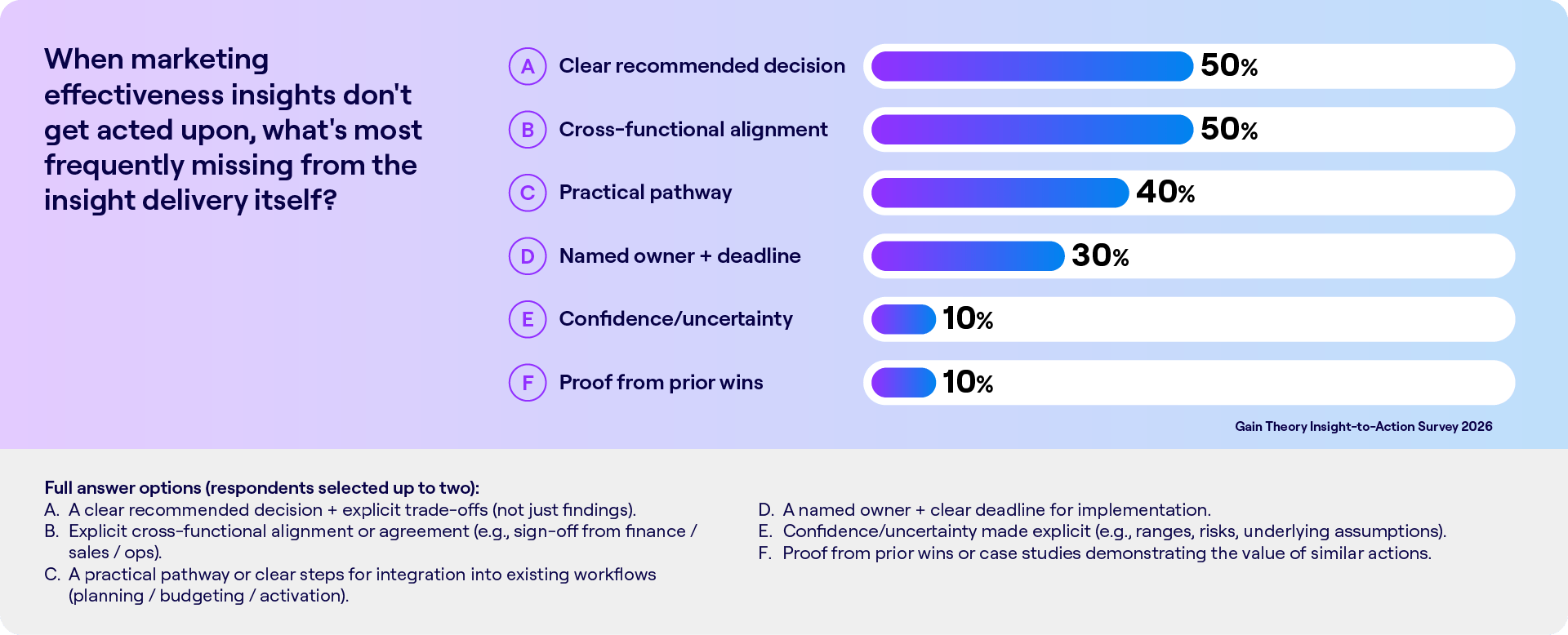
My analysis: What stands out here is how important the delivery of the insight impacts its actionability. It’s not enough to present marketing insights that only reveal what has happened in the past. As an industry, we have a responsibility to provide the wider business with a clear path forward too. The high ranking for both ‘a clear recommended decision and explicit trade-offs’ and ‘a practical pathway or clear steps for integration’ tells me that marketers agree. To achieve this, insights should include recommendations about what should be done and how.
To build the organizational muscle that enables intelligence to be translated into business impact on a consistent basis, insights also need to be consumable and directly actionable within existing workflows. But improving how insights are packaged is only part of the challenge. Even well-constructed insights face significant headwinds once they leave the analyst’s hands.
The hard part begins after an insight is delivered
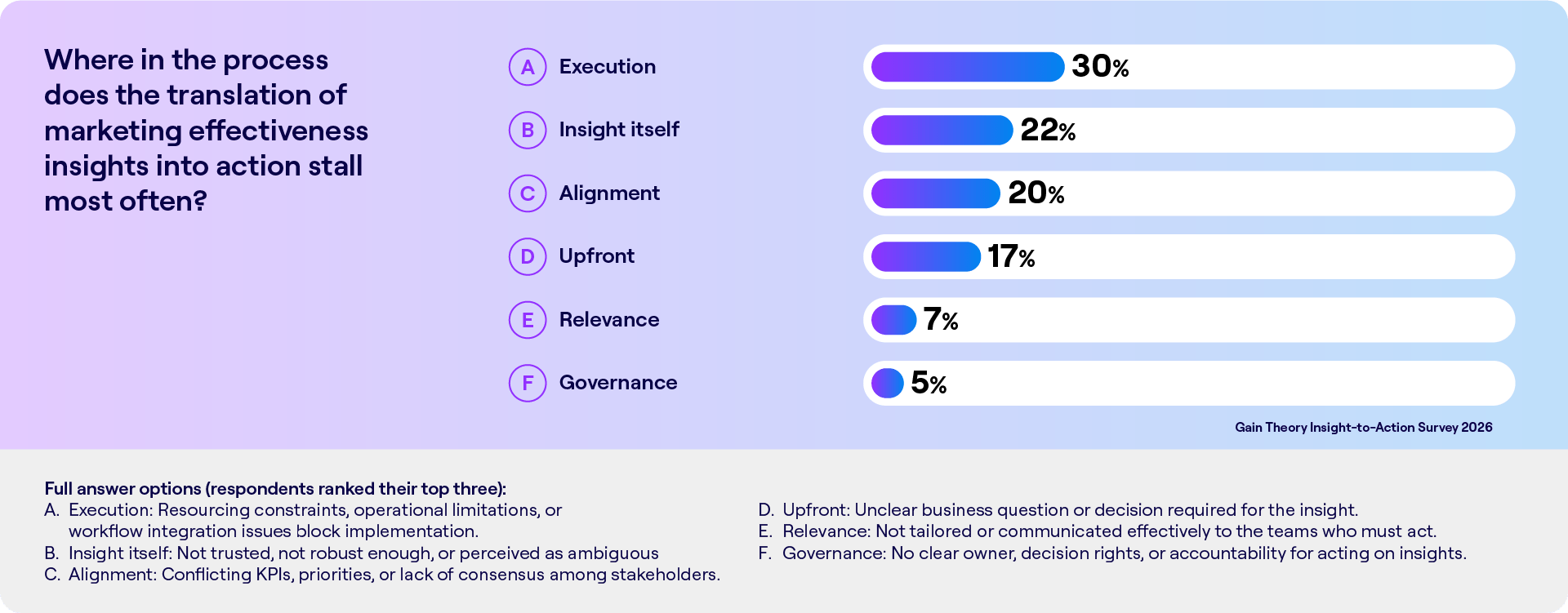
My analysis: This chart really gets to the heart of the unfinished business we talk about in our report. The fact that ‘execution’ emerges as the top reason why insights stall is telling. It reinforces our core message that the challenge isn’t always the quality of the insight itself; rather, it’s the human and cultural dynamics that kick in after the insight is generated. Marketers intuitively understand that getting different departments on the same page and ensuring they have both appropriate resources and clear accountability are the biggest hurdles that need to be overcome. This is a deep-seated organizational challenge that requires brands to start a change management journey, rather than simply acquiring more data or faster analytics.
Everyone agrees org silos are killing adoption
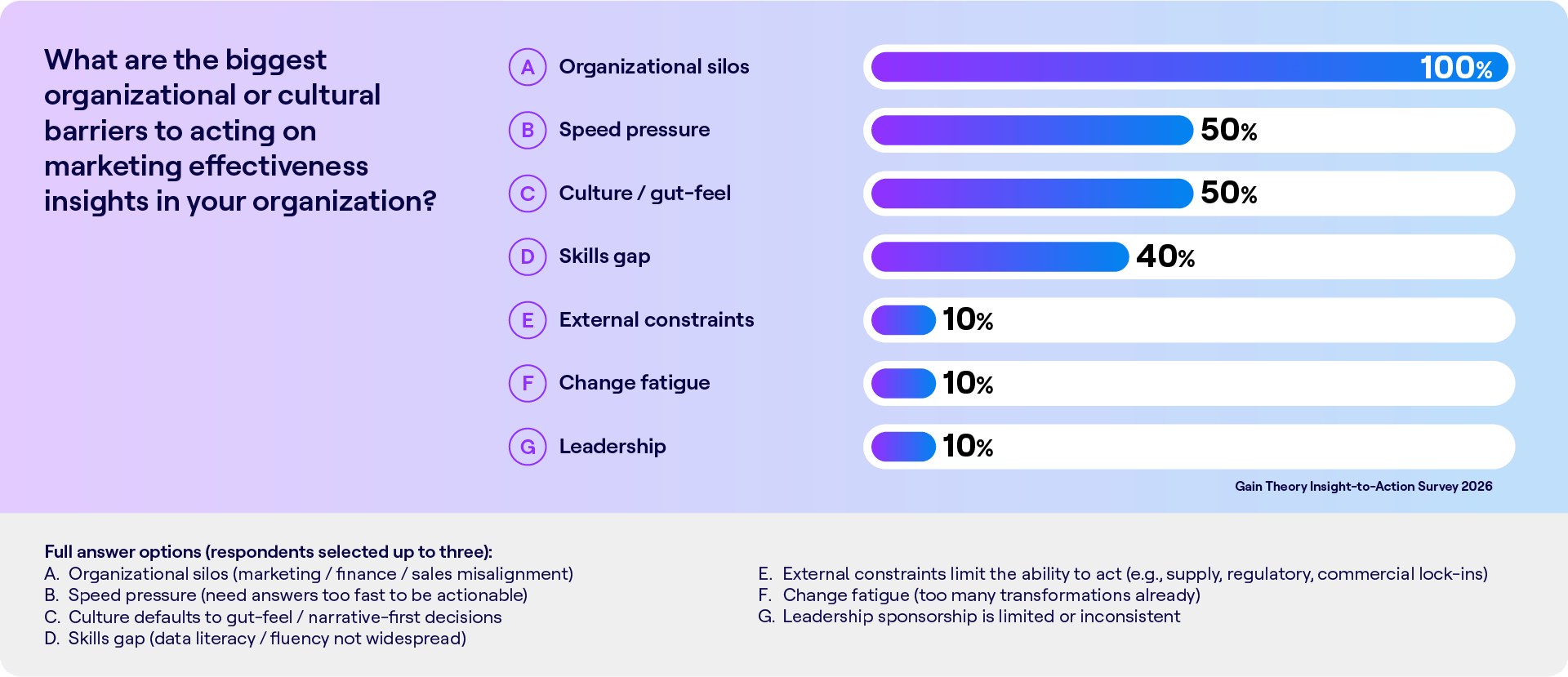
My analysis: These results confirm our hypothesis that key barriers to insight adoption are deeply rooted in organizational and cultural factors. ‘Organizational silos’ being cited by every respondent clearly indicates where the biggest friction lies. Along with ‘speed pressure’ and a ‘culture that defaults to gut-feel’, the results demonstrate again that this isn’t about a lack of good data or models but the internal dynamics that prevent insights from gaining traction. When different departments operate in silos, potentially holding on to their own truths, it takes time and clearer leadership mandates for insights to be actioned. This is why marketing effectiveness transformation requires a deliberate effort to foster collaboration and secure executive buy-in.
The strategic, systemic fixes marketers want
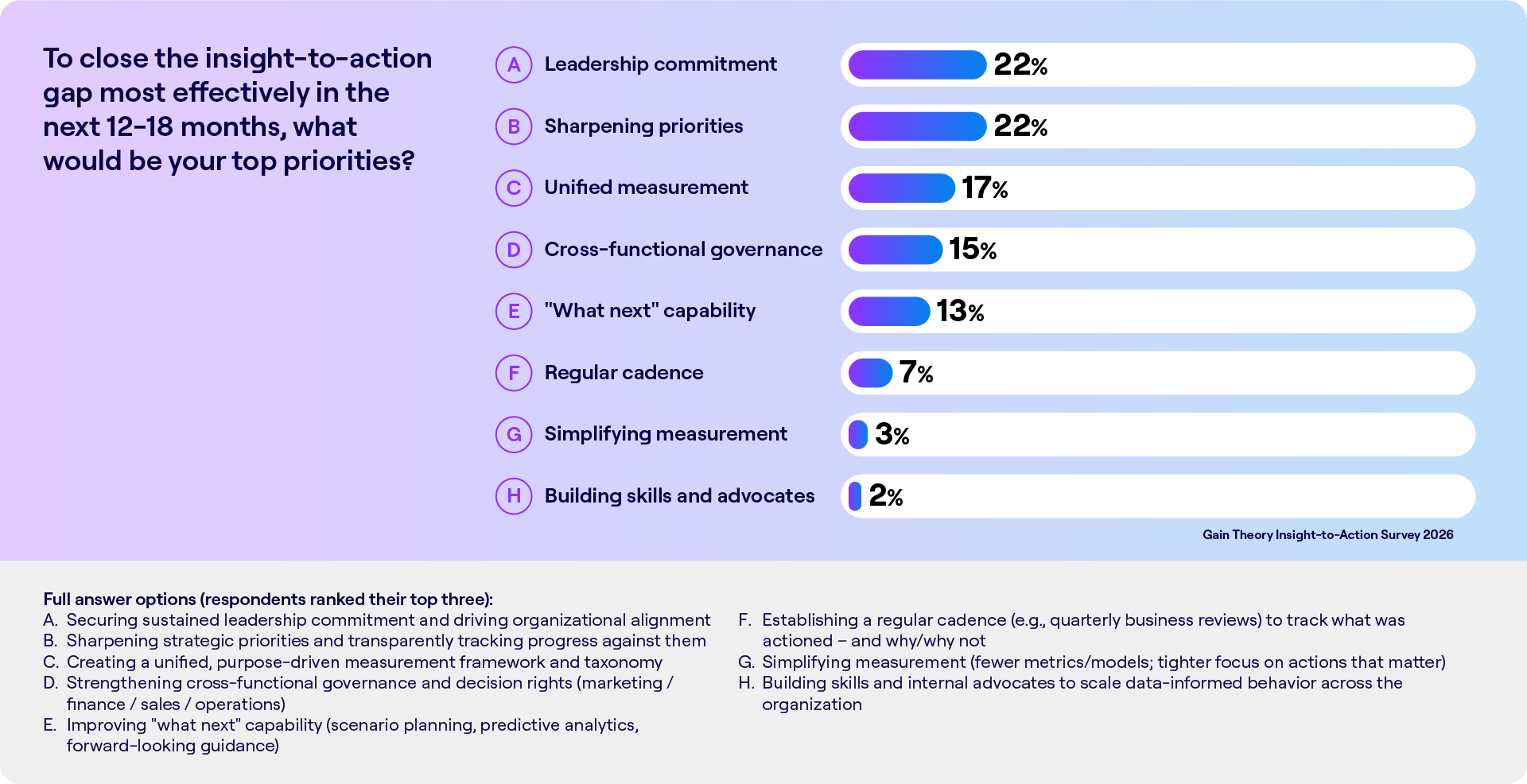
My analysis: It’s encouraging to see that marketers recognize the most effective solutions are strategic and systemic. The emphasis on ‘securing sustained leadership commitment and driving organizational alignment’ and ‘sharpening strategic priorities’ clearly indicates that they understand this isn’t just a tactical fix. These two priorities represent a fundamental shift in how organizations operate, and they are deeply interconnected.
Leadership commitment provides the essential mandate needed to challenge the status quo, overcome silos, and move beyond gut-feel decisions. Without it, even the clearest strategies struggle to gain traction. In turn, sharpening strategic priorities gives that leadership commitment a tangible direction. It provides the common language and shared KPIs needed to align disparate teams and bridge the insight-to-action gap.
These two priorities must evolve in parallel. Together, they enable marketers to directly address the root causes we identified earlier: visible leadership secures the resources needed to overcome ‘execution’ challenges, and clear priorities ensure that insights are focused on ‘what next’ rather than just ‘what happened,’ thereby improving the ‘context’ and ‘actionability’ of the insights themselves.
The insight-to-action gap won’t close itself
The picture these four data points paints is pretty clear. The insight-to-action gap opens up in how insights are packaged, in the execution challenges they face once delivered, and in the organizational culture that makes change so hard to drive. Closing it requires more than better analytics or faster data. It requires brands to engage in marketing effectiveness transformation and, more broadly, change management.
Download Unfinished Business: Closing the Insight-to-Action Gap to learn more